

Our Latest News

New campaign addresses ineffective support for dyslexia in work
New campaign addresses ineffective support for dyslexia in work
Dyslexia Scotland has unveiled a new national campaign to help ensure Scots with dyslexia can access the support, resources and reasonable adjustments that help them work and learn as equals alongside their peers.
 The campaign responds to concerning research by the charity and the University of Glasgow, which revealed that less than half of workers with dyslexia in Scotland are provided with reasonable adjustments at work and, shockingly, a quarter of those who receive them do not find them helpful.
According to Acas, the UK public body that helps resolve workplace disputes and improves employer-employee relations, reasonable adjustments are changes an employer makes to remove or reduce a disadvantage related to someone’s disability. They are tailored to an individual’s needs, and employers have a legal duty to make reasonable adjustments where required.
Dyslexia is the most prevalent learning difference that affects around one in ten people in Scotland and can be considered a disability under the Equality Act 2010.
The employment rate for disabled people has consistently been lower than that of non-disabled people in Scotland. Inaccessible recruitment procedures, digital barriers and non-inclusive workplaces are among the factors that prevent disabled people from securing or staying in employment.
Dyslexia Scotland’s campaign supports the Scottish Government’s ambition to halve the Disability Employment Gap by 2038.
The Right Tools for the Job campaign features recommendations from people with dyslexia about the adjustments and approaches that help them work and learn at their best. Throughout Dyslexia Awareness Week, Dyslexia Scotland will lead a programme of social media content, events and resources that encourage educators, employers and service providers to create more inclusive environments while enabling people with dyslexia to self-advocate for their rights and needs.
Chief Executive of Dyslexia Scotland Cathy Magee said: “Dyslexia Scotland believes that work and learning should be neuro-inclusive. That means creating environments where systems adapt to people, rather than people having to adapt to systems.
“But until that happens, people with dyslexia need to be able to ask for – and receive – reasonable adjustments that help them work and learn within the systems we have today. We’re urging the dyslexic community to speak up and ask for the things you need to help you make your best contribution at work and in learning, and to change-makers to create the conditions for people with dyslexia to thrive. During Dyslexia Awareness Week, we encourage everyone to follow our campaign, come to our free events and download our materials. Every positive action is another step towards a dyslexia-friendly Scotland.”
The charity, which works with schools, employers and communities across Scotland, hopes the campaign will increase the number of people accessing effective reasonable adjustments in learning and the workplace.
Dyslexia Awareness Week Scotland 2026 runs from 28 September to 4 October.

Asda creates 210 new supported internships for young people with special educational needs
Asda creates 210 new supported internships for young people with special educational needs
Asda has become the country’s largest supported internship provider after creating 210 new placement opportunities for young people with special educational needs and disabilities (SEND) across 35 stores nationwide.
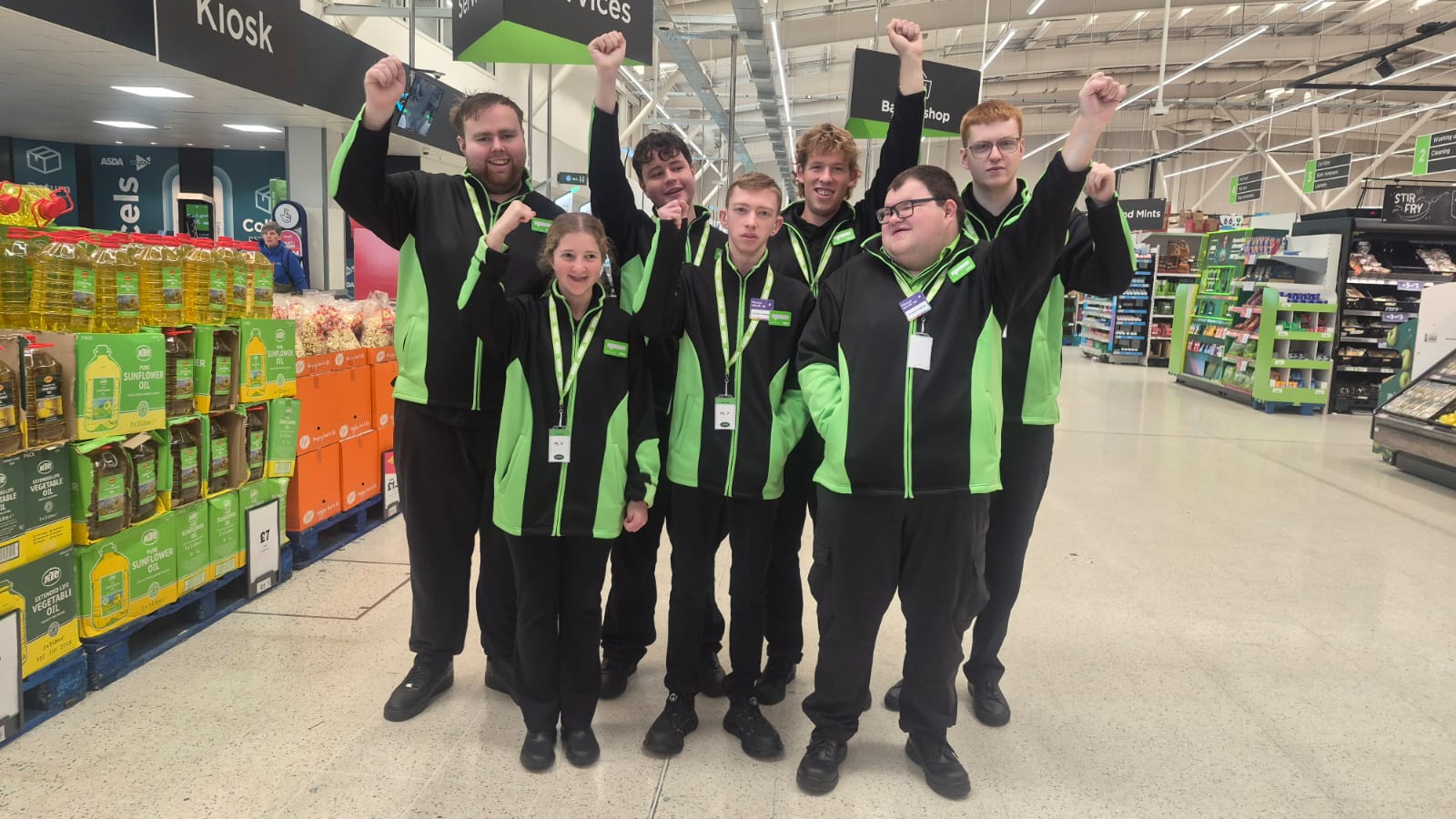 The expansion means Asda’s supported internship programme now operates in more locations than any other UK business, addressing a significant employment gap facing young people with learning disabilities. Only 4.8% of people in England and 4.1% in Scotland with a learning disability go on to secure paid employment after completing their education, compared with around 80% of their peers.
Delivered in partnership with DFN Project SEARCH, Asda’s year-long Supported Internship programme combines real workplace experience with tailored education and employability training, helping young people develop the skills, confidence and experience needed to eventually move into work.
Since Asda began working with DFN Project SEARCH in 2023, 43% of interns have progressed into employment – be it with Asda or another business*. With fewer than 6% of young people with learning disabilities in paid work nationally**, supported internship programmes like Asda’s play a vital role in helping participants take their first steps into the workplace.
The expansion comes at a time when policymakers and employers are increasingly focused on tackling youth economic inactivity and creating more pathways into employment for young people who face barriers to work.
James Goodman, Chief People Officer for Asda, said: “We’re incredibly proud to be expanding our Supported Internship Programme and giving more young people with special educational needs the chance to gain real workplace experience.
“Supported internships have been shown to be an effective route into work and we’ve seen first-hand the difference these placements can make, helping young people to build confidence and take important steps towards paid employment. As we continue to grow the programme, we hope more young people can benefit from supported internships and the opportunities they create to build skills, gain experience and move into work.”
Kirsty Matthews, CEO of DFN Project SEARCH said: “We are delighted to see the expansion of our successful programmes with Asda. Through such strong employer partnerships, we are showcasing the incredible impact that supported internships can have.
“We’re so grateful to work with companies like Asda because they demonstrate that when businesses make disability inclusion a priority, everyone benefits. These young people have so much to offer, and programmes like this give them the platform to showcase their talents and build meaningful careers. We look forward to continuing to work with Asda to reach our overall goal of supporting 10,000 young people into employment by 2030.”

OUT TODAY: Hr NETWORK Magazine September 2026 Issue
OUT TODAY – READ THE LATEST ISSUE OF: Hr NETWORK Magazine September 2026
Small Business In A Sea of Big People Issues
How can smaller businesses adopt broader HR functions to add value to their organisations? Many often feel like they’re sinking, overwhelmed in a sea of people challenges but adopting a proactive HR approach, even in an SME environment can strengthen people processes, reduce risk, and boost team performance. Andy Moore takes a closer look…
Also in the latest issue:
- Introducing the Judges for the Hr NETWORK National Awards 2026
- SPECIAL FEATURE: Reviewing the Hr NETWORK Breakfast Club for August 2026
- The regular sections of the magazine include: News, STATS and EXTRA
- The ‘Insights’ section features first class comment from those in the know on a range of subjects including: AI within Learning & Development; Fire Safety in the Workplace
Click the front cover below:


AI can’t fix productivity if the workplace is broken!
AI can’t fix productivity if the workplace is broken!
Businesses have spent billions adopting AI tools, new software, new platforms and new ways of automating work, yet most offices today look almost identical to what they did a decade ago. The same open plan layouts, with lots of noise, interruptions and expensive distractions. The technology has evolved, but the workplace hasn’t, and that disconnect is where productivity is being lost. That’s the view of Tyson Gundersen, Co-Founder of Bureau.
Workplace distraction is estimated to cost UK businesses around £488 billion every year. As organisations invest heavily in AI to improve efficiency, many continue to overlook one of the biggest barriers to performance, the physical environment people work in every day.

As return to office mandates continue across both the public and private sectors, this matters more than ever. The challenge is no longer convincing people to come back into the office, it’s ensuring the office is somewhere people can actually concentrate and do their best work.
The Real Productivity Challenge
The biggest barrier to performance today isn’t a lack of talent or technology, it’s cognitive overload. The average worker switches tasks or is interrupted every few minutes, with research suggesting it can take up to 23 minutes to fully regain concentration. Microsoft’s 2025 Work Trend Index found employees are interrupted by meetings, emails or messages as often as every two minutes throughout the working day. Across an organisation, that’s an enormous loss of focus, productivity and ultimately cost.
Too much workplace technology has added to this problem by creating more dashboards, more notifications and more digital noise, yet AI offers the opportunity to reverse that trend. Instead of competing for employees’ attention, it can reduce friction, automate low value tasks and protect the focus that employees depend on.
The Office Needs to Catch Up
That theory extends beyond software to the workplace itself. For decades, office layouts were designed once and left largely unchanged, regardless of whether they actually supported the people working within them. Now, however, AI driven space planning is changing that by enabling organisations to understand how workspaces are genuinely being used and adapt layouts based on real behaviour.
Booking systems, acoustic monitoring and environmental controls can work together to identify quieter spaces, reduce distractions and continually improve the workplace over time. For the first time, organisations can measure not just revenue, output and headcount, but also focus, friction and whether the workplace genuinely supports the work happening inside it.
That gap between expectation and reality is already showing up in the data. A 2024 University of Pittsburgh study found that 99% of organisations implementing return to office mandates experienced a decline in employee satisfaction. If businesses expect people back, the workplace itself has to work harder to support focus, wellbeing and performance.
Designing for Human Performance
Workplace design should actively support concentration, privacy and productivity, rather than simply provide somewhere for people to sit. The future office won’t be defined by AI alone, or by design alone, but by the combination of intelligent technology and environments built around how people actually work.
For the first time, organisations can use data not just to measure productivity, but to improve the conditions that enable it, transforming office design from something static into something dynamic, continually adapting to reduce friction, protect focus and support better performance.
Businesses have spent years asking how AI can make employees more productive. The better question is how AI can help create workplaces where productivity is actually possible. AI didn’t create the modern office’s biggest challenges, but combined with smarter workplace design, it may finally help solve them.

Women build tighter workplace friendships than men, according to new research
Women build tighter workplace friendships than men, according to new research
The researchers found women were more likely to befriend a friend of a friend, creating larger workplace cliques and friendship groups. These ‘friend of a friend’ relationships were more likely to be reciprocated and with other women. Men, by contrast, tended not to form friend of a friend work friendships, which suggests they make friends with people they see they can benefit from being close to.
 These findings come from research by Andrew Parker, Professor in Leadership at Durham University Business School, alongside colleagues from William and Mary’s Raymond A. Mason School of Business and Università della Svizzera Italiana, who wanted to understand how female friendships differed compared to male friendships in the workplace.
To do so, the researchers conducted a longitudinal study on almost 150 employees , following their first ten months within the organisation. Over this period , workers were asked numerous questions at four points in time around the friendships they had made.
The results showed that female workers were much more likely to create tighter connections in the workplace with other women, which suggests they focused less on what they could get out of the relationship, and more just on the friendship. Men, on the other hand, appeared to be more selective in their friendships, having specific one-to-one friendships with other men in their workplace – especially when they see that relationship as beneficial to their goals.
“Creating friendships at work is vital for employee morale, support and also productivity – with studies showing that people who have a close friendship at work are more likely to be engaged in their work, more productive and more innovative,” says Professor Parker.
“However, our research shows that the impact of friendships at work differs when it comes to men and women,” says Professor Parker. “In fact, our research shows that female friendships are often contributing to the stability of an organization, whereas men’s friendships are more focused on their own benefits.”
The researchers say that how women and men see workplace relationships could be contributing towards the gender pay gap – with women’s friendships offering less networking, resources and influence, whilst men’s friendships are likely seeing them receive preferential treatment, given the intentionality of those friendships.
The researchers suggest that organisations should try to increase the opportunities that all workers have to network and improve their relationships with everyone in the company – so that everyone has an equal opportunity to build friendships with people for mutually beneficial opportunities.

Why employers are struggling to offer the apprenticeships young people are asking for
Why employers are struggling to offer the apprenticeships young people are asking for
Apprenticeships have never had a better reputation. As university costs continue to rise and employers place greater value on practical skills, more young people are looking at apprenticeships as a direct route into employment. Yet despite growing interest, apprenticeship opportunities remain limited across much of the UK. While politicians continue to promise more opportunities, employers face barriers to creating them.
According to Oliver Sidwell, careers expert and co-founder of Higherin, the issue is not a lack of enthusiasm for apprenticeships themselves, but the realities businesses face when trying to deliver them. “There’s a misconception that employers are unwilling to invest in young people,” says Oliver. “The truth is many businesses recognise the value of apprentices and would like to hire more of them. The challenge is that taking on an apprentice has become increasingly difficult to justify financially, particularly for smaller employers.”
 The cost of training the next generation
For many businesses, apprenticeships represent a long-term investment rather than an immediate solution to staffing shortages. Apprentices require training, supervision and dedicated support before they become fully productive members of a team.
“When a business takes on a new apprentice, they are effectively committing to several years of development,” Oliver explains. “That means dedicating experienced staff to mentoring, covering training requirements and accepting that there will be a period where the apprentice is learning rather than contributing at full capacity.”
The pressure on smaller businesses
The impact is being felt most by small and medium-sized enterprises (SMEs), many of which already face tighter financial pressures than larger employers.
“A large organisation might have dedicated HR teams and established training programmes,” says Oliver. “A business with twenty employees does not have those resources. Every hour spent on administration or supervision is time that could have been spent serving customers or generating revenue.”
Rising employment costs have only intensified the challenge. SMEs are contending with higher wages, increased National Insurance contributions and broader economic uncertainty, making long-term recruitment commitments harder to make. When employers are focused on managing costs and protecting margins, apprenticeships can feel like a luxury rather than an investment. That’s especially true in sectors where businesses are already struggling to recruit skilled staff,” he explains.
There is also growing concern that the apprenticeship system itself has become overly complex.
“Many employers tell us they are put off by the bureaucracy involved. Businesses want to focus on training young people, not navigating complicated funding rules, compliance requirements and administrative processes.”
Young people are ready for apprenticeships
At a time when industries ranging from engineering and construction to technology and healthcare continue to report skills shortages, thousands of young people are competing for a relatively small number of apprenticeship places.
“We see huge demand from school leavers,” says Oliver. “For many young people, an apprenticeship is no longer a second choice behind university. It’s their preferred route into a career because it offers work experience, earnings and qualifications at the same time.”
Research consistently shows that apprenticeships can lead to strong long-term earnings and progression opportunities. Yet access remains constrained because employer demand has failed to keep pace with interest from applicants.
“If the government is serious about tackling skills shortages, the conversation cannot focus solely on encouraging young people to apply,” he argues. “We also need to understand what is preventing businesses from creating more opportunities in the first place.”